« July 2008 | Main | September 2008 »

August 2008 Archives

August 5, 2008

Dunham Place

Forgotten NY has an article today about Dunham Place, one of the two shortest streets in Williamsburg (Fillmore Place being the other). Dunham Place is the one-block street that runs between Broadway and South 5th Street, a block east of Kent Avenue. As Forgotten says, the street opened in 1850 and is home to a number of impressive late-19th century loft buildings. According to an 1827 map of the Village of Williamsburgh, a "Mr. Dunham" (probably David Ross Dunham) owned a large house on the south side of South 7th Street (now Broadway), facing the head of what would become Dunham Place (there is an extremely ugly building there now). This was a stone house originally constructed by a Capt. D. Griswold; Dunham later constructed a larger house, referred to as the Dunham Mansion, north of Broadway - probably in the vicinity of today's Dunham Place.

[As with Fillmore Place, the historic block on which Dumham sits was very large and eccentric to the street grid; it would be interesting to know if the opening of Dunham was a speculative real estate venture as well.]

Dunham Place was not the first street in Williamsburg to be named after entrepreneur and property owner David Dunham. That honor goes to Grand Street, the lower portion of which (i.e., the stretch west of Bedford Avenue) was once called Dunham Street. Actually, that was the second name for Grand Street, as Grand Street from the river to Roebling was laid out as Washington Street in 1812 by Thomas Morrell, one of Williamsburgh's founding fathers. At that time, he also named the spit of land that jutted into the East River (the area just west of Grand Ferry Park today) Morrell Point.

David Dunham purchased Williamsburgh (yes, apparently all of it - which at the time probably meant from Division Avenue to somewhere north of Metropolitan, and the East River to Bedford) at a sheriff's auction in 1818. Dunham's son, David Ross Dunham, opened the first steam ferry service from Williamsburgh to Manhattan. Dunham pere expanded his Williamsburgh holdings in 1821 by purchasing the the farm of John Conselyea, which was located on either side of South 6th Street, from the East River to just east of Berry Street. David Dunham was also responsible for establishing the first school in Williamsburgh, donating a plot of land on the block bounded by North 1st, Berry, Grand and Bedford ("where the old log cabin stood"). There, the Bushwick District School was constructed in a one-story frame building.

August 7, 2008

Most Holy Trinity Church

1.JPEG
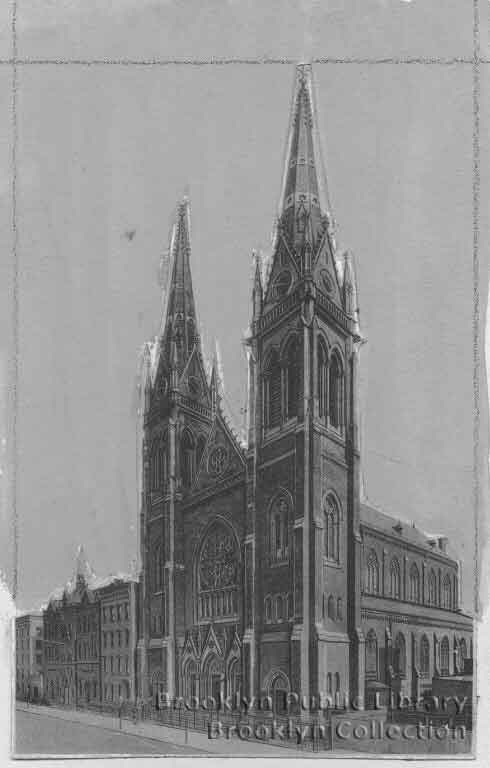
Most Holy Trinity Church, Montrose Avenue
William Schickel, architect
Photo: Brooklyn Public Library

Gowanus Lounge had a post a week or two back about Holy Trinity Cemetery, a small German Catholic cemetery in Bushwick (next door to the larger Cemetery of the Evergreens). The cemetery was originally located behind Most Holy Trinity Church, in Williamsburg.

Now known as Most Holy Trinity and St. Mary*, the parish was originally founded as the German Church of the Holy Trinity in 1841. It was the first National parish in the Brooklyn diocese, and the first German Catholic Church in Williamsburg. It was also the mother church for a host of other German parishes over time. Holy Trinity was founded by Father John Raffeiner, a wealthy doctor-turned-priest from Austria. Raffeiner came to the United States in 1833, settling in New York where, in 1836, he founded St. Nicholas Church on East 2nd Street (the oldest German church in the New York Diocese). Raffeiner is also credited with establishing a German parish in Boston during this period. In 1841, Raffeiner moved to Williamsburg, a village that at the time was seeing a huge influx of German emigrés. There, largely with his own funds, the priest purchased property on Montrose Avenue from Abraham Meserole.

The first church of Most Holy Trinity was a frame structure, completed in 1841. A rectory was constructed in 1844. In 1853, the parish constructed a new church building on the corner of Montrose and Graham (it was for that church that the parish's cemetery was moved). Between 1863 and 1871, Holy Trinity's parish boundaries were divided numerous times - yielding Annunciation (1863), St. Nicholas (1865), All Saints (1867) and St. Leonard's (1872) parishes. Still, the original Holy Trinity parish continued to grow, and in 1880, construction began on a new church (on the site of the original frame church). The cornerstone for the new church was laid in 1882, and the building was completed in 1885. The new church was constructed of Belleville (N.J.) brownstone, with two towers of 250' each and a 70' tall nave (the spires, also constructed of brownstone, were covered in lead sheets in 1990).

The architect for the new church was William Schickel. Schickel was active in the late 19th century; he designed a number of churches and German-related structures in New York and Brooklyn. Among his more prominent works are the Century Building on Union Square (now home to a Barnes & Noble), the Freie Bibliothek und Lesehalle on Second Avenue (now the Ottendorfer branch of NYPL) and, next door, the German Poliklinik (now the Stuyvesant Polyclinic Hospital)

Betty Smith (née Elisabeth Wehner), author of "A Tree Grows in Brooklyn" was baptized at Holy Trinity in 1897. In her novel, the church is described as "the most beautiful in Brooklyn... it was made of old gray stone and had twin spires that rose cleanly into the sky, high above the tallest tenements".

The parish's property encompasses much of the block bounded by Graham, Johnson, Manhattan and Montrose. It includes the former Catholic Orphan Asylum on Graham Avenue (erected between 1865 and 1885), two school buildings, a rectory and a faculty residence. The rectory which appears to have been constructed in 1872 (Joseph Berendach, architect), is located immediately east of the church. The elementary school is located to the east of the rectory; constructed in 1888, it was, prior to its closing in 2005, the oldest parish school in Brooklyn. The high school, which closed in 1972, was located on Johnson Avenue. In the 1880s, the church's two schools enrolled 1,600 students. The faculty residence, at the corner of Montrose and Manhattan, was designed by Beatty and Berlenbach in 1952. In addition to the buildings on its block, Holy Trinity was responsible for the construction of the original St. Catherine's Hospital, on Bushwick and Devoe.

Most Holy Trinity & St. Mary Church is just one of many significant remnants of Williamsburg's German past. The building itself, together with its associated structures, is a landmark in every sense of the word. With the recent merger of Most Holy Trinity and St. Mary, MHT's might seem secure. But its roll of parishioners (now almost exclusively Hispanic) continues to dwindle, and most of its associated structures sit vacant. With any luck, the rectory, elementary school, asylum and faculty residence will find new and compatible uses.

*Most Holy Trinity merged with Immaculate Conception of the Blessed Virgin Mary Church in 2007. St. Mary's was founded in 1841 as an Irish church, and was located at Leonard and Maujer Streets.

Sources:
Most Holy Trinity - St. Mary: History
Most Holy Trinity - St. Mary: Tour of the Church
New York Architecture Images
BushwickBK - Bushwick Geographic: Most Holy Trinity Cemetery
Smith, Betty A Tree Grows in Brooklyn
"Five Years in Building: The New and Handsome Church for German Catholics in Williamsbug." New York Times, August 24, 1885, page 8.
100th Year Marked by Brooklyn Church." New York Times, October 13, 1941, page 12.
"Catholicism: A Significant Page of Local History." Brooklyn Daily Eagle, April 1, 1877, page 4.
"Local Improvements." Brooklyn Daily Eagle, July 26, 1872, page 3.
"A New Parochial School." Brooklyn Daily Eagle, May 14, 1888, page 6.
"Building Plans Filed." New York Times, June 23, 1952, page 32.

More photos after the jump...
Continue reading "Most Holy Trinity Church" »

August 21, 2008

Environmental Concerns Raised About Brooklyn Con Ed Plant

Councilmember Eric Gioia raises concerns about Con Ed's hasty demolition of the former BRT Power Plant at Kent and Division. (Where is our Councilmember on this issue?)

If its any consolation, WGPA has reviewed a host of environmental records for this property, and none of them mention asbestos "baked into the walls", as Con Ed has claimed. There was asbestos associated with piping and machinery, all of which could have been removed without taking a brick off the building. And there was lead paint in the building (as there is in every 100-year-old building), which also could have been removed without lifting a wrecking bar.

If you want to talk about environmental issues, look to the empty lot immediately south of 500 Kent. That lot is home to a former Brooklyn Union Gas manufactured gas plant.

Curbed has more here.

August 24, 2008

Austin Nichols Cleans Up

Last week, Curbed posted a photo set showing the progress of paint stripping at Austin Nichols (184 Kent). The white paint is off on most of the north side, exposing the original concrete substrate (if you look carefully, you can see the board marks from the original formwork). We don't know what the original finish for the building was - exposed concrete or a skim coat of sort? But we look forward to seeing the finished result.

The stripping also shows that beneath all the cosmetic ugliness, the building is in quite sound condition. It reminded us of a meeting we had with CM Yassky about three years ago - one of his reasons for opposing landmark designation was the deplorable eyesore condition of the facade. We said at the time that the facade was easily repaired, but the owner had convinced the council member otherwise. Maybe now Yassky believes us?

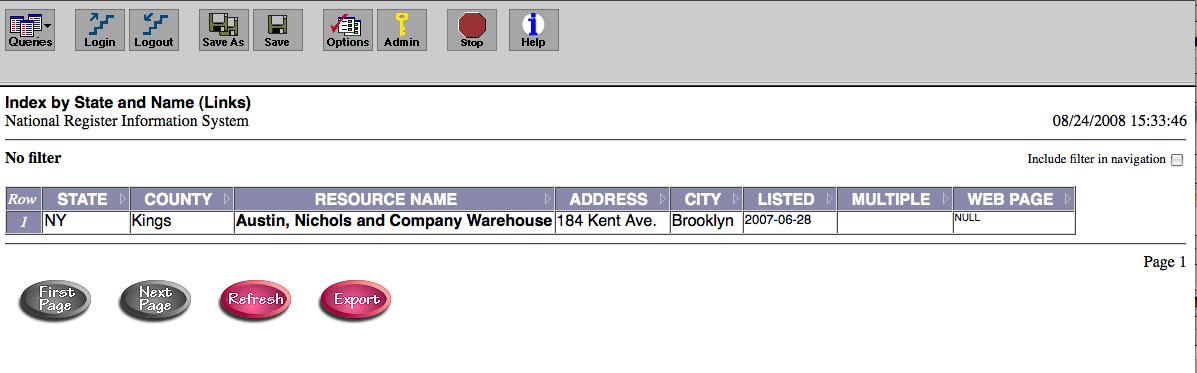
On a related note, the owners of 184 Kent have since listed their building on the National Register of Historic Places (WGPA applied for a determination of eligibility, which was granted by the State Preservation Office, but the owner did the actual listing on the National Register).

August 31, 2008

Astroland Closing (For Good?)

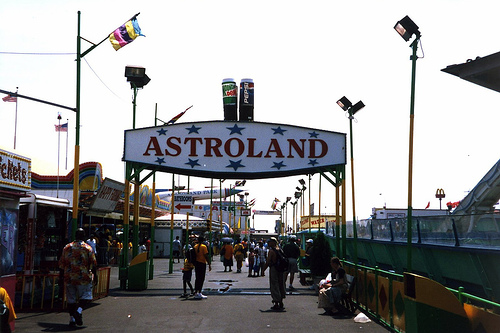
wallyg-astroland.jpg
Astroland
Photo: wallyg

Elsewhere in Brooklyn, the Astroland amusement park in Coney Island, is shutting its rides down for good this Thursday. In a letter in the Daily News, Astroland's owner blames landlord Thor Equities. (For its part, Thor says Astroland is giving up too soon.)

Another nail in the coffin for open-air amusements in Coney Island?

About August 2008

This page contains all entries posted to WGPA in August 2008. They are listed from oldest to newest.

July 2008 is the previous archive.

September 2008 is the next archive.

Many more can be found on the main index page or by looking through the archives.

Creative Commons License
This weblog is licensed under a Creative Commons License.