« August 2008 | Main | October 2008 »

September 2008 Archives

September 1, 2008

McCarren Pool Update

mccarren-zack.jpg
Photo: Zach K

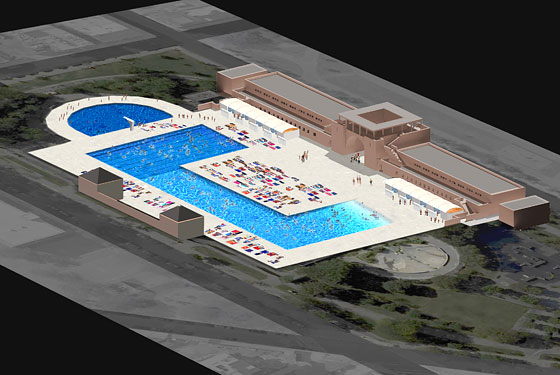
On Tuesday, 9 September, the Landmarks Preservation Commission will be holding a public hearing on the plans to renovate the McCarren Park pool. Until then, here is some recent background on the pool, the closing and the plans to reopen it, courtesy of the Brooklyn Rail.

ANCW Cleaning Photos

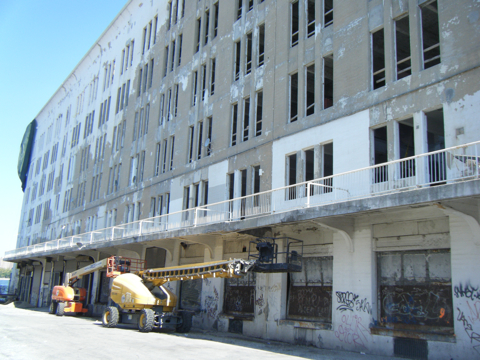
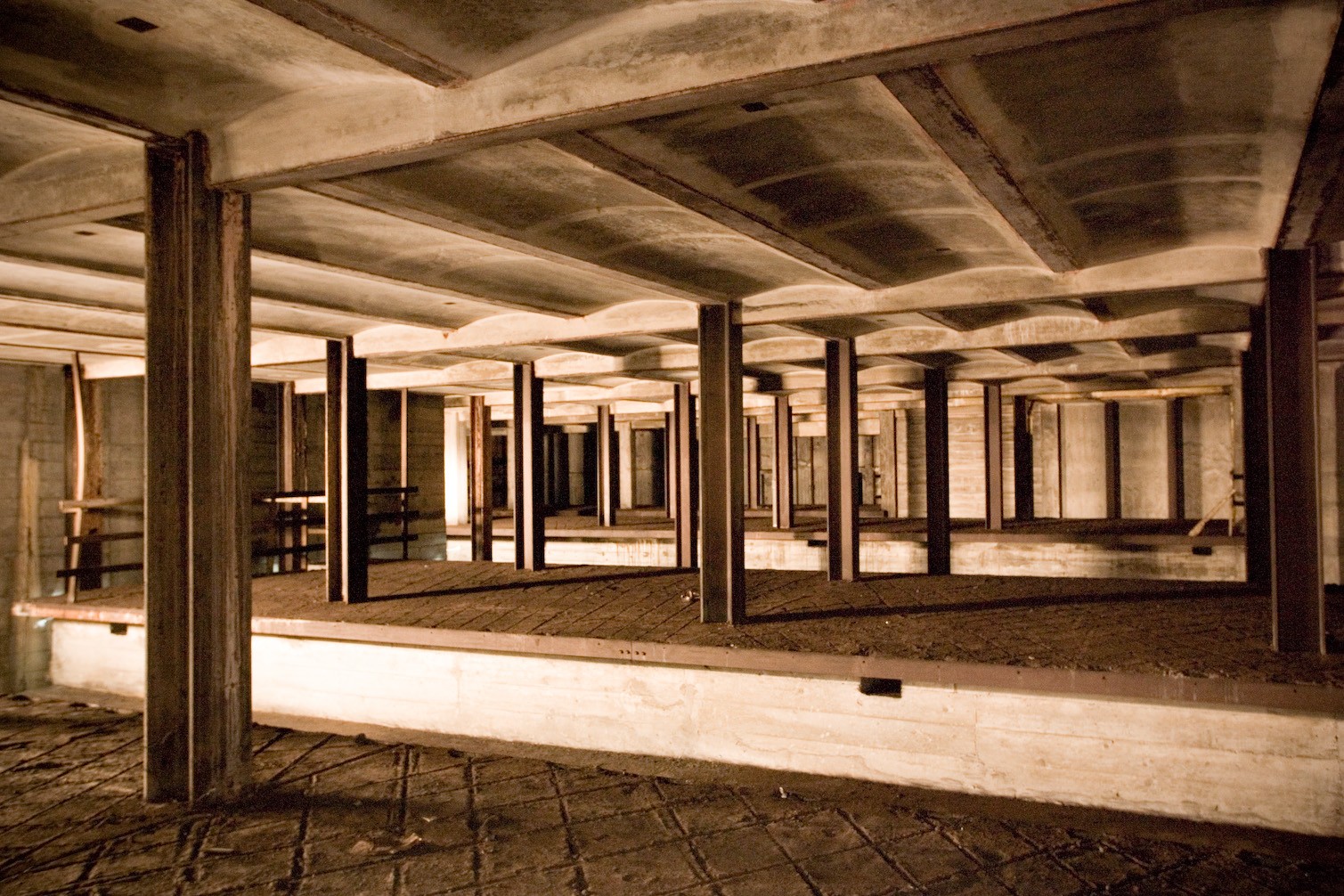
Last week we mentioned the cleaning and paint stripping at the Austin Nichols building. Herewith, some photos of the same. It may not be apparent in the photos, but in person you can see the horizontal marks of the boards that were used for the formwork. As we said last week, the underlying reinforced concrete appears to be in very good condition for its age - a testament to Gilbert's design and Turner's construction (remember too, that this entire building was constructed in less than a year).

ancw-clean-1.JPG.jpg
North facade (facing Northside Piers).

ancw-clean-2.JPG.jpg
South facade.

Fillmore Fire

22 Fillmore fire.jpg
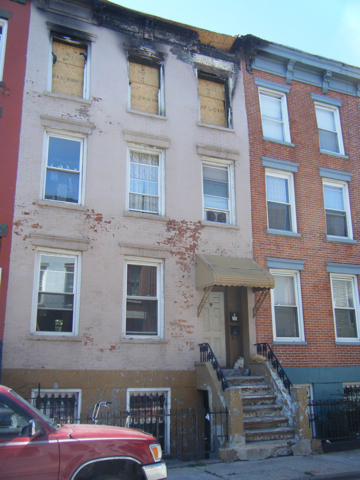
22 Fillmore Place, August 2008.


This is old news by now, but over the summer (in June?) there was a pretty sizable fire at 22 Fillmore Place. The fire gutted the third floor; the cornice and brownstone at the third-story lintels were pretty heavily damaged.

Luckily, no one was injured and the damage was contained.

22 Fillmore Place is one of twenty two row houses constructed in the early 1850s by Alfred Clock and Ephraim Miller. Eighteen of those row houses survive today, and they form the core of a proposed Fillmore Place Historic District. WPA requested that the Fillmore Place Historic District be designated an official New York Historic District in September 2007. The Landmarks Preservation Commission is reviewing this request and is expected to act on it in the near future.

September 2, 2008

Another Power House

442-Rodney.jpg
Ainslie Street Station of the Municipal Electric Light Company (ca. 1889).
Photo: PropertyShark

For the past few months, WPA (and everyone else) has been focused on Con Ed's demolition of the former Brooklyn Rapid Transit power station at Kent and Division. Just in the past few weeks we have learned that Con Ed's definition of sustainability includes green roofs, but does not include recycling buildings. We also learned that Con Ed does not want to be forthcoming with the details on its environmental remediation.

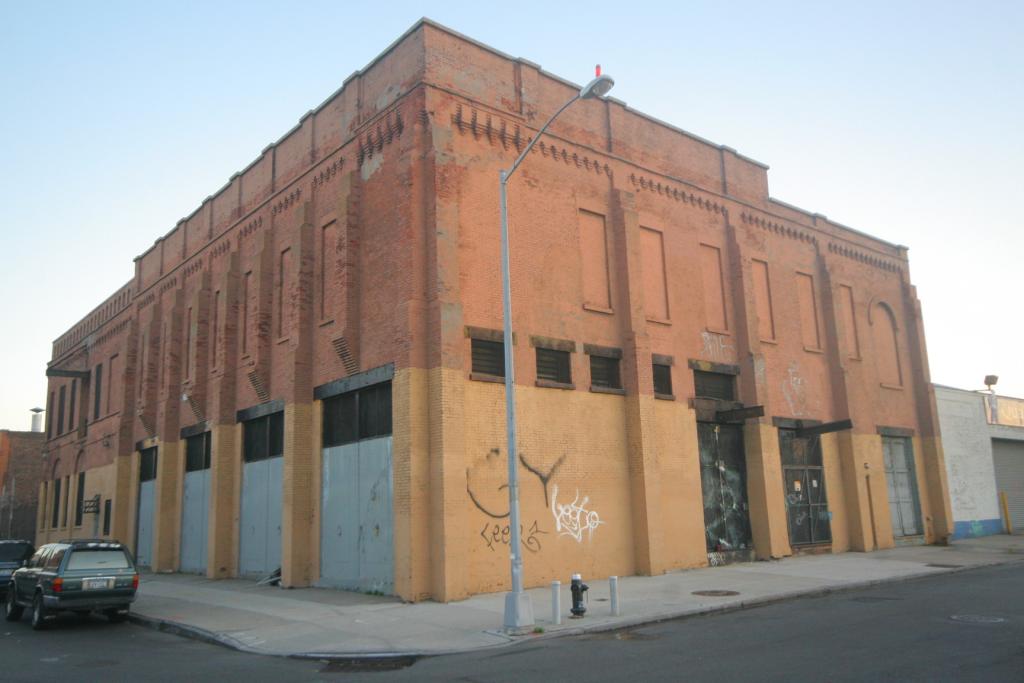
It turns out that the old BRT plant is not the only legacy power plant in Williamsburg that Con Ed owns. Far less grand - but potentially of even greater historic significance - is the the former Ainslie Street Station of the Municipal Electric Light Company of Brooklyn. This building - now scaffolded and possibly being prepped for demolition (though the only permit on BIS is for pointing and masonry repairs) - sits astride the BQE at the corner of Rodney and Ainslie.

308-penn.jpg
308 Penn Street
Photo: PropertyShark

Municipal Electric was formed in 1884 to electrify Williamsburg and provide street lighting. The company constructed three power plants in the area - Ainslie Street, 308 Penn Street (right) and South 5th Street near Bedford. The Bedford plant was demolished at the turn of the 20th century as part of the construction of the Williamsburg Bridge. The Penn Street building and the Ainslie building both survive. What sets Ainslie Street apart, though, is the fact that was designed as a power station, not like the typical commercial building of the day (as Penn Street was).

Based on preliminary research, the Ainslie Street station was constructed in 1889. It is certainly one of the oldest, if not the oldest, purpose built electrical generating station in Brooklyn (and the city overall). WPA has requested that the Landmarks Preservation Commission review this building for designation as an individual New York City landmark. Earlier this year, LPC refused to consider the BRT plant for designation; we can only hope that Ainslie Street is different.

September 9, 2008

LPC Hearing on McCarren Today

14_mccarren1_lg.jpg

The Landmarks Commission will hold a hearing on the Parks Department's plans for the rehabilitation of the McCarren Park Pool today (early after. WPA supports the plans, which will return the pool to a pool use and will bring a year-round use to the pool. The proposed rehabilitation includes the reopening of the diving pool at the east end of the site, and the construction of new pavilions on the pool deck in front of the shower wings. And, of course, the plan includes significant amounts of restoration for the pool structures themselves. All in all, this plan is a major victory for the Williamsburg community, and we hope it gets built as soon as possible.

The hearing will be held at the Landmarks Preservation Commission, 1 Centre Street, 9th Floor North, Manhattan. The hearing is scheduled for 3:30.

September 10, 2008

LPC Approves McCarren Pool Makeover

14_mccarren1_lg.jpg


At its public hearing yesterday, the Landmarks Commission unanimously approved the redesign for McCarren.

Now let's get building.

September 15, 2008

Subway Expansion in Williamsburg

As you might imagine, our interest was piqued when we saw this item in the FYI column of yesterday's City Section:

Q. Most subway stops’ names use only the street number (42nd Street, for example). How come West Fourth Street and a few stops in the Bronx (like East 180th Street and East 149th Street) are given an east/west distinction?

A. Mainly to avoid confusion.

Herb Schonhaut, manager in New York City Transit’s Office of Station Signage, said the Fourth Street station uses the word “West” to distinguish it from the planned but unbuilt “South” Fourth Street Station in Williamsburg, Brooklyn.

South Fourth Street station?

Indeed. It seems that back in 1929 (before the consolidation of the various subways systems under City control), there was a bold plan (called the IND Second System) to expand the City's subway system. The plan was called the IND Second System, and during the 1930s parts of it were built. The plan was scrapped with the consolidation of the BMT and IRT lines in 1940.

The proposed service to Williamsburg included two new lines: one connecting to the Sixth Avenue line and running beneath the East River from Houston Street; the second connecting to the Eighth Avenue line and running under the River from Grand Street in Manhattan (with the last stop at Columbia Street). In Williamsburg, the north line was to run beneath Grand Street as far as Driggs, and then turn south to meet up with the second line, which was to run under Broadway and South Fourth Street (more detail here). All of this was to meet up with the Crosstown Line (aka the G train) at Broadway and South 4th. That was the South 4th Street station referred to in the Times article (portions of which were built: see below). From South Fourth Street, the lines continued east. In Bed Stuy, they were to branch off. The Utica Avenue would run to the south, eventually winding up in Sheepshead Bay. The Rockaway line would continue northeast along Myrtle and Central Avenues, and then turn south and run all the way to the Rockaways.

Think about it, instead of being the redheaded stepchild of the transit system, the G train would have been an integral part of the largest interchange in the entire subway system.

South4-Etsy.jpg
View of the South 4th Street Station
Photo: Etsy

September 16, 2008

St. Paul's Evangelical Lutheran Church

StP-WPA.jpg
St. Paul's Evangelical Lutheran Church.
View from South 5th Street over the BQE.
Photo: WPA

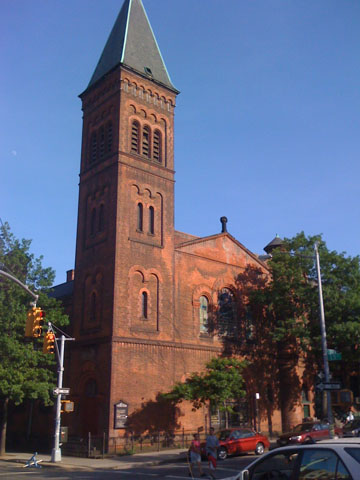
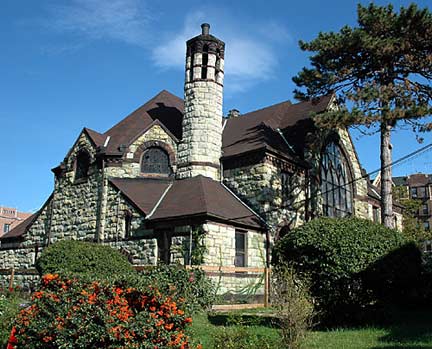
Today, we continue our intermittent series on the churches of north Brooklyn. You might remember that a few weeks ago we wrote about Most Holy Trinity Church on Montrose. This week we are highlighting another German congregation - St. Paul's Evangelical Lutheran on South 5th and Rodney. If you take the J/M/Z, you will recognize it immediately (particularly if you wait for the train at the Marcy Avenue stop). Theology aside, St. Paul's has a lot in common with Holy Trinity: both were founded as German congregations; both are among the oldest congregations in Williamsburg; both buildings date to the 1880s; and both buildings were designed by prominent New York City architects. At St. Paul, the architect was J. C. Cady (who designed the American Museum of Natural History, among many others). And in this case, the architect was responsible for the entire complex of buildings - church, rectory and parish house.

St. Paul’s Evangelical Lutheran Church is located on the corner of South Fifth Street and Rodney (formerly Ninth) Street in the Williamsburg section of Brooklyn. The complex of buildings, which includes the Church, Sunday School and Parsonage, were constructed in 1884-85 to the designs of J. C. Cady & Company. The buildings were designed in the Romanesque style and constructed of Holland and Philadelphia brick with terra cotta and brownstone trim.

Check out the full history after the jump

Continue reading "St. Paul's Evangelical Lutheran Church" »

September 18, 2008

Work Begins At McCarren Pool

Via Brownstoner, evidence of actual work at McCarren Park Pool!

September 19, 2008

Memorial Plaques Going Missing

Bronze plaques from throughout the neighborhood continue to be stolen and, presumably, sold for scrap. Assemblyman Lentol is proposing legislation to stop the thefts. Since theft and possession of stolen property is already illegal, perhaps some enforcement of existing laws and public pillorying of the scrap metal dealers accepting these pieces is what is really in order.

The Glass Stampede

beforeafter_odm.jpg
80 Metropolitan (from New York).
Credit: Courtesy of Lou Madigan (l); courtesy of Kim Wendel Design LLC (r).

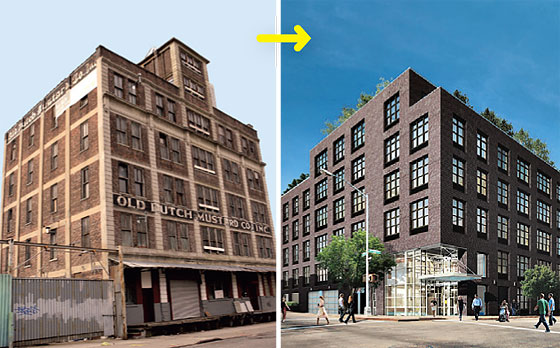
New York's Justin Davidson has written a long and thoughtful piece on the architectural transformation of New York City these past few years (its a week or two old by now, but we're just getting around to it). The article includes before and after pictures of 54 of the 76,000 (!) new buildings constructed since 1993, as Davidson attempts to answer the question "has this ferment improved New York or eaten away at the city’s soul?". In the end, Davidson concludes that while "[it] would be wonderful if we could stem the Avalonization of New York simply by demanding better buildings... (Good Design Now!)", "most architecture in any age is crap, and today’s crap isn’t as bad as yesterday’s". Based on his analysis, we can buy that, though his thesis certainly applies better to Manhattan than Brooklyn. Why does Brooklyn (and LIC) get all the missed opportunities?

All in all its a very good article - the more so because we tend to agree with most of his calls. Both the good (Rossi's Scholastic, ShOP's Porter House, Nouvel's 40 Mercer and Piano's Morgan Library to name a few); and the bad (of course, Greenberg Farrow's Dutch Mustard 80 Metropolitan, Gruzen Sampton's J Condo, O'Hara's Ten63). On Dutch Mustard, Davidson has this to say:

Rather than renovate, Steiner NYC tore down the rather fancy Old Dutch Mustard plant and worked up a new six-story residential complex, currently under construction. There is no evidence that it will be marvelous enough to take the bite out of the loss.

We couldn't have said it better (though we have certainly said it fairly often).

September 22, 2008

Week Ahead 22 September

A few things happening in the coming week or so:

Monday, 22 September (6:00 p.m.)
Hitting the Streets, from Harlem to East New York
Dramatic videos that investigate New York City neighborhoods from an on-the-ground perspective. This screening will showcase the results of an innovative workshop in which students from Hunter College's Urban Affairs & Planning and Integrated Media Arts (IMA) programs explored the use of media for community organizing aimed at improving the quality of local environments. The evening includes the installation HAVEMEYER STREET. This installation begins with several hanging prints depicting developer fantasies of new luxury condo buildings in Williamsburg, Brooklyn. Behind the prints, two video screens show the reality of how people on two sides of one street in transition experience the process of gentrification in this area. The video progresses down the street, examining different spaces and meeting diverse business owners and residents.
Where: Hunter College's Lang Auditorium, North Building, 4th Floor (the North Building is located on 69th Street between Park and Lexington, on the south side of the street).
Cost: FREE and open to the public (with a reception to follow).

Saturday, 27 September (11:00 a.m. - 1:00 p.m.)
Toxic Hazards & Cultural Treasures.
Join the winner of this year’s Jane Jacobs Medal for Lifetime Achievement on a bus tour highlighting issues of environmental justice in Harlem. This tour will examine how noxious hazards such as garbage and bus depots — often place there by the city government — co-exist with some of the city’s cultural treasures, such as the museums and arts institutions of “El Barrio,” Marcus Garvey park and the new Harlem Waterfront Park. Leader: Peggy Shepard, co-founder and executive director of West Harlem Environmental Action (WE ACT).
Where: Meet at WE ACT offices 71 West 125th Street, #308, just east of Frederick Douglass Boulevard next to the Blimpie and Duane Reade stores.
Cost: Limited space. $25, $20 MAS members/students. Purhcase tickets online or call 212-935-2075.

Monday, 29 September (6:30 p.m.):
Concrete Realities: Preserving Modern Concrete Architecture.
The Columbia Historic Preservation Program and DOCOMOMO US have organized a debate on the preservation of modern concrete architecture (particularly relevant if you've been watching the progress at Austin Nichols). Speakers include architect Mark Pasnik, conservator Norman Weiss and historian Tim Rohan. Theo Prudon of DOCOMOMO US is the moderator. (This panel is a prelude to a three-day conference at Columbia entitled "Solid States: Changing Time for Concrete - the Second Columbia Conference on Architecture, Engineering and Materials", which will start on 1 October.)
Where: Wood Auditorium, Avery Hall, Columbia (116th & Broadway).
Cost: Free.

September 23, 2008

Bay Ridge U. M. C.

bayridgemethodist_z.jpg
Photo: Forgotten NY


It would appear that the fate of Bay Ridge's Green Church has been sealed - and its not a pretty fate. After much back and forth, the church has officially obtained demolition permits. Next up, a dumpster and a Bricolage design (the former is probably the nobler fate; Dante has a circle for the latter). And then a seven-story condo. The church already been picked over by Olde Good Things, so presumably all that is left is the shell and the stuff that won't sell on 24th Street.

The church is officially known as Bay Ridge (or Grace) United Methodist Church, and was constructed in 1899 to the designs of George W. Kramer. It was much beloved, and there was a lot of support within the community to preserve the structure (almost 1,200 residents signed petitions to support saving the church). The church was listed on the National Register of Historic Places in 1999, but NYC Landmarks has refused to consider designation. This is an all-too-familiar scenario, particularly when it comes to churches. Despite the fact that most churches have clear social and cultural significance to their communities (significance that often extends beyond their own congregation or denomination), and despite the fact that many churches (like Green Church) are architecturally significant, there is clearly an unwillingness on the part of LPC to individually designate churches. Most churches in NYC that are protected by LPC are protected because they fall within historic districts, not because LPC has found them significant in their own right.

The sad part of all this is that there are often viable redevelopment options that can retain the historic churches. Yes, these options usually result in less profit than demolition, but the benefits to the community are clear. And in most cases, the developers wind up using the history of the buildings as a selling point. In Brooklyn, there are at least two recent examples - the Sanctuary in Fort Greene (formerly Our Lady of Pilar R.C. Chapel), and the former St. Peter Church on Hicks Street in Cobble Hill.

In the past few weeks, we have highlighted two of the many churches in Williamsburg, Bushwick and Greenpoint (we have a lot more coming). Holy Trinity Church, on Montrose, was constructed in 1884; St. Paul's Lutheran Church on Rodney, was constructed in 1882. Both parishes date to the 1840s - Holy Trinity is the second oldest Catholic congregation in North Brooklyn, and the oldest national parish in all of Brooklyn; St. Paul's Lutheran is the second oldest Lutheran congregation in North Brooklyn, and the oldest extant. Both buildings were constructed by prominent and accomplished architects of their time - William Schickel in the case of Holy Trinity; J. C. Cady in the case of St. Paul's. Both churches are also significant reminders of the ascendency of the German immigrant population in North Brooklyn in the mid to late 19th Century. Despite all of this history, and the clear architectural significance of these two buildings, the likelihood of them becoming landmarks is pretty slim - nonexistent if the churches themselves object. And yet objectively, both churches are clearly worthy of serious consideration for designation as individual landmarks. We suspect the same was true of Green Church.

September 28, 2008

Week Ahead: 29 September

A few things happening in the coming week or so:

Monday, 29 September (6:30 p.m.):
Concrete Realities: Preserving Modern Concrete Architecture.
The Columbia Historic Preservation Program and DOCOMOMO US have organized a debate on the preservation of modern concrete architecture (particularly relevant if you've been watching the progress at Austin Nichols). Speakers include architect Mark Pasnik, conservator Norman Weiss and historian Tim Rohan. Theo Prudon of DOCOMOMO US is the moderator. (This panel is a prelude to a three-day conference at Columbia entitled "Solid States: Changing Time for Concrete - the Second Columbia Conference on Architecture, Engineering and Materials", which will start on 1 October.)
Where: Wood Auditorium, Avery Hall, Columbia (116th & Broadway).
Cost: Free.

Tuesday, 30 September (6:30 p.m. to 7:30 p.m.):
North Brooklyn Compost Project Fundraiser.
Learn how to lower your urban-eco footprint, meet other folks in the community interested in composting, join our raffle to win prizes, bid on items for the silent auction, and help us raise funds for the expansion of the North Brooklyn Compost Project while eating snacks and toasting to our worms with a glass of sangria. $10 suggested donation at the door. Our guest speakers include No Impact Man; Colin Beavan, and the North Brooklyn Compost Masters; Kate Zidar, Griffin Thomas, & Natasha Heflin. Raffle prizes and silent auction items are donated by: Urban Rustic, Brooklyn Kitchen, Brooklyn Botanical Garden, Council on the Environment of NYC, Lodge Restaurant, Habana Outpost, Sprout Home, Ronnybrook, 3r Living, Penny Licks, and Word Books Stationary Kid's Stuff.
Where: Urban Rustic, 236 North 12th St (across the street from Greendome Community Garden).
Cost: $10 suggested donation.

Thursday, 2 October (7:00 p.m.):
NAG Town Hall Organizing Committee.
NAG (Neighbors Allied for Good Growth), a community organizing group in Williamsburg and Greenpoint, is having a Town Hall Meeting on 10/2 to mobilize the community on the most important issues we are facing. Longtimers will remember NAG as one of the leading voices against waste transfer stations on the waterfront, against Radiac, and for intelligent rezoning that protects jobs and housing. As NAG looks to the future, it is holding this meeting to take the pulse of the community and start to identify the issues the community will organize around in the coming years.
Where: Holy Ghost Hall, 159 North 5th St (between Bedford and Driggs).
Cost: Free.
September 29, 2008

NAG Town Hall

nag town hall2.jpg

NAG (Neighbors Allied for Good Growth), a community organizing group in Williamsburg and Greenpoint, is having a Town Hall Meeting on 10/2 to mobilize the community on issues facing Greenpoint & Williamsburg. Longtimers will remember NAG as one of the leading voices against waste transfer stations on the waterfront, against Radiac, and for intelligent rezoning that protects jobs and housing. As NAG looks to the future, it is holding this meeting to take the pulse of the community and to identify the issues the community will organize around in the coming years.

The Town Hall will take place at the Holy Ghost Hall, 159 North 5th St (between Bedford and Driggs) on Thursday, 2 October at 7:00.

Metro on Manhattan

Metro gives Manhattan Avenue the "City Blocks" treatment. Not a very upbeat assessment, but from the sounds of it, they only made it to one store on Greenpoint's main thoroughfare.

For what its worth, we still find the pierogis great, and would stand in line at Lomza any day of the week. And there is still plenty of great shopping Manhattan Ave. And a nice little historic district too. So support your local merchant - and the economy.

September 30, 2008

Why?

north4thfactory1.jpg
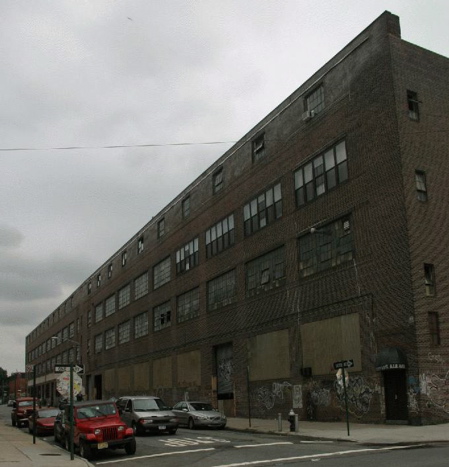
92 North 4th Street, before.
Photo: Gregg Snodgrass, PropertyShark.

steelworks.jpg
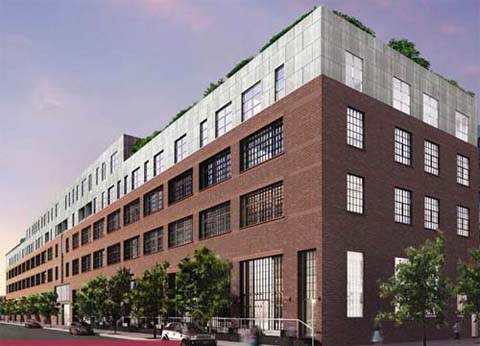
Steelworks, after (via Curbed).
Architect: Gene Kaufman.

Granted, the loft building on North 4th between Berry and Wythe (now branded Steelworks Lofts) isn't going to win any beauty pageants. But we're a little unclear as to how recladding the top floor helps things in any way.

Of course architect Gene Kaufman's current design is a far sight better than his original proposal.

184 Kent: Paint & Windows

In Curbed's latest update on the rehabilitation of the Austin Nichols & Co. Warehouse, the north facade is getting painted (white), and some windows are going in. This will be a very handsome building once its restored, which is, of course, what we thought all along.

Work Begins at the 87th Precinct

87th_precinct.jpg
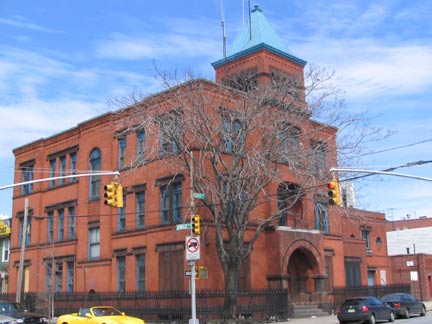
Former 87th Precinct.
Architect: George Ingram (1891).
Photo: Forgotten NY.


In news of work at an actual City landmark, Newyorkshitty reports that hammers are swinging at the former 87th Precinct. The building (on Humboldt and Herbert, but maybe best known from the BQE) is being converted into affordable housing by the North Brooklyn Development Corporation, Greenpoint's local non-profit development group.

87th_tower.jpg
Former 87th Precinct, tower.
Architect: George Ingram (1891).
Photo: Forgotten NY.

About September 2008

This page contains all entries posted to WGPA in September 2008. They are listed from oldest to newest.

August 2008 is the previous archive.

October 2008 is the next archive.

Many more can be found on the main index page or by looking through the archives.

Creative Commons License
This weblog is licensed under a Creative Commons License.