« February 2008 | Main | April 2008 »

March 2008 Archives

March 1, 2008

Upcoming: Greenway Meeting

There will be a joint meeting of the Parks, Transportation and Waterfront Committees of Community Board #1 on Wednesday, 5 March 2008, to discuss the proposed Brooklyn Greenway initiative in Williamsburg and Greenpoint.

WGPA urges people to come out and show support for bicycles and trees over parking spaces.

Date: Wednesday, March 5
Time: 6:30pm
Location: Upstairs room at Lady of the Snow Society Inc. (410 Graham Avenue, between Withers and Jackson).
Closest subway: L train, Graham Avenue stop.
Read more: CB1 Workshop Findings (large pdf)

March 2, 2008

March 3rd: McCarren Push for Parks

McCarren Park has long been poised for a rebirth, and this meeting is an important step in ensuring that what happens to our park happens with our input.

From OSA & GWAPP:

Hey McCarren Park user!

You use the park. You want it to be better. You’re not alone. Share your ideas on Monday March 3 (7pm @ Auto High Library).

The best way to get the parks we deserve is through persistent community attention to each park. GWAPP (Greenpoint Waterfront Association for Parks & Planning) is helping kickstart a big (and sustained) Push for Parks all across our North Brooklyn neighborhoods to create (where one doesn’t exist) support (where one does exist) and unite (where, as with McCarren Park, several active groups co-exist) park-specific Friends Groups.

The purpose of these groups will be to gather information about the way the community uses the parks, the issues and needs of each park and to establish a community representatives for each park, who persistently push for improvements – whether from the city, the Open Space Alliance for North Brooklyn (www.openspacealliancenb.org), neighbors, local businesses, grants…

This is the initial meeting of what, for now, might be called the United Friends of McCarren Park. With the improvements planned for McCarren Park's Pool/Ice Skating Rink and Skate Park, this is the time to plan for additional improvements throughout the entire McCarren Park. We need to make sure we have a unified and coherent voice in the way the park is maintained and plans are made for future developments.

With the Pool reconstruction underway (design-wise at least) it seems the various user-groups of this potentially wonderful park have a shared purpose. Let’s use it to make the park better.

Here’s a proposed (and very preliminary) agenda:

  • Request a comprehensive survey & study of park usage & potential improvements
  • McCarren Park Pool – reconstruction status update
  • Pool-adjacent “Comfort Stations” – can these be built first?
  • Fieldhouse “Comfort Stations” – the most disgusting bathrooms in Brooklyn?
  • Wading/Spray Pool – what can be done to have this running by summer?
  • Benches & Paths
  • Natural turf conditions
  • Gardens & Trees
  • Dog Run(s)
  • Plan to artificially turf paved field next to tennis courts
  • Plan to study de-mapping Driggs and/or Union Ave. through the park
  • Concerts, Films & other programming
  • Other issues & needs?

WHEN: Monday, March 3 at 7pm

WHERE: Automotive High School Library (Bedford Ave. across from McCarren ballfields, next to tennis courts)

Everyone interested in working together to improve McCarren Park is welcome!

March 4, 2008

LPC to Domino: Not Yet

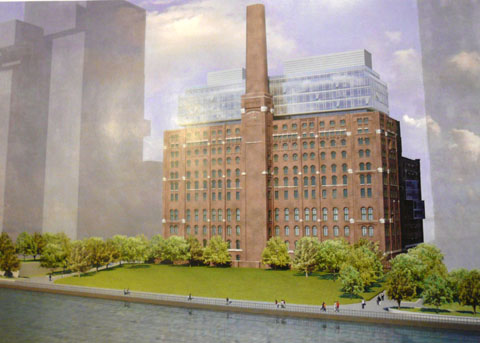
river_rendering.jpg

The Landmarks Preservation Commission finally held part 2 of the Domino hearing this morning. Community Preservation Corporation reiterated its case, that this addition was necessary for the lofty goals of the overall project. Beyer Blinder Belle, architect for the addition, compared their design to not only the Tate Modern, but also the Morgan Library and the Hearst Tower. Even Rafael Viñoly was there in person to make the case for the overall project. Councilmember Diana Reyna gave the only public testimony, in favor of the large addition.

And then the Commissioners had their say.

In a nutshell, the majority of the Commissioners felt that addition was too tall and that it was not the the right design for this building. A couple of Commissioners were OK with the general height of the addition, but not the design. In terms of design, there seemed to be a consensus that this design was too "tame" and did not reflect the character or strength of the landmark itself. Some Commissioners encouraged the architects to be "more visionary" and to emphasize the "industrial rigor" of the landmark. NONE of the Commissioners said no addition whatsover. ALL of the Commissioners thought that the 3-story bulkheads had to go. (And no one was buying the Tate Modern comparison.)

As for the rest of the project, the Commissioners largely echoed WGPA's comments there too. They liked the concept of the windows on the south wall echoing the conveyor bridges, but thought the current solution was also too tame. The storefronts and ground floor entries were called "unconsidered" - a position we also wholly agree with.

In the end, no vote was taken. CPC was asked to go back to the drawing board and take the comments into account. Given that some of the comments were at cross purposes, they have a job cut out for themselves. In the end, though, the Commissioners did the right thing - Williamsburg deserves a better design that what CPC has brought forward to date.

We look forward to seeing more.

March 6th: Forgotten NY at Word

Kevin Walsh of Forgotten New York will be at Word this Thursday to give a presentation on Forgotten Greenpoint. We're looking forward to this one. Kevin's talks - like his books, tours and website - are always interesting.

March 7 - 9: HDC's Annual Conference

HDC Presents Its 14th Annual Preservation conference, Preservation 2030

March 7-9, 2008

PlaNYC 2030 is a broad initiative put forth by Mayor Michael Bloomberg to enhance New York’s urban environment for the future focusing on sustainable goals for land, air, water, energy and transportation projects. One of the main premises of the plan is that New York City will receive an additional one million residents in the next two decades. Many in the preservation community want to know how the city can accommodate this growth and still retain its historic character. Using the Mayor’s PlaNYC as a starting point, the Historic Districts Council’s 14th Annual Preservation Conference will focus on preservation and its relation to a broad framework of urban issues and how they relate to New York’s many diverse neighborhoods. The HDC conference will utilize original research, real-life case studies, panel discussions and community tours to talk about preservation and development in the future, especially through the lens of the 2030 Plan and its land use initiatives.

A distinguished group of preservationists, planners, elected officials, government agency representatives, architects and educators from across New York City’s five boroughs will address these issues. These panelists are all intimately invested in the development and land use concerns of their communities and will dissect PlaNYC and it’s implications for our city’s future. The Conference will consist of three panel discussions: “Surviving the Building Boom: Urban Neighborhoods of the Future,” “Building it Out: Suburban Neighborhoods of the Future” and “Tools of the Trade: Preservation Practices for the Next Generation.”

Full details on the conference are available from HDC. In addition to the conference panels, there will be a series of walking tours on Sunday, March 9. (Including a Greenpoint-Williamsburg tour by Ward Dennis of WGPA.)

March 9: After the Plan, a Walking Tour

Part of HDC's 14th Annual Preservation conference, Preservation 2030

GREENPOINT & WILLIAMSBURG: AFTER THE PLAN

In the aftermath of the Williamsburg-Greenpoint upzoning, the area immediately surrounding McCarren Park has undergone a drastic transformation. Once predominantly comprised of low-rise row houses and apartment buildings, the Park’s borders are now dominated by luxury condominiums built of materials and to a scale out of context with the rest of the neighborhood. Tour guide Ward Dennis (of WGPA) will highlight this severe new construction and how it’s affected surrounding areas.

The tour costs $25 - register here.

March 10, 2008

Dutch Mustard News!

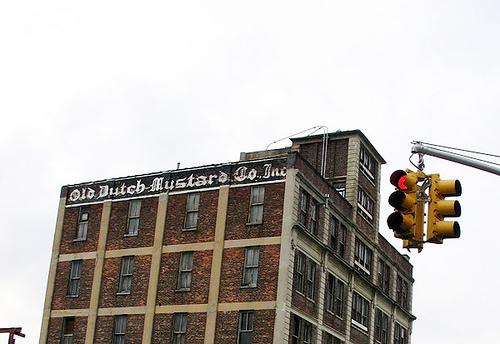
We're not exactly sure why this requires a press release now; perhaps some press flack is catching up on the development news. Or perhaps they're being green and recycling last year's news. Anyhow, the "news" is this - Steiner Equities has chosen architecture firm GreenbergFarrow to design a "warehouse-inspired condominium and townhouse project in Williamsburg, Brooklyn... GreenbergFarrow will transform the long-shuttered site of the Old Dutch Mustard Co. into 80 Metropolitan, a six-story building with 114 lofts and nine three-story townhouses".

That probably sounds familiar, as Steiner demolished the Dutch Mustard building two years ago, and construction on the site has been going on for the better part of a year. (Seriously, we read about it here.)

odm.jpg
Old Dutch Mustard Co.
Photo: Maria Sochaniewicz

Here's more from Navid Maqami, principal of architecture at GreenbergFarrow: “80 Metropolitan will incorporate many forward-looking design elements but will at the same time incorporate the character of the neighborhood, which was once dominated by factories and warehouses". Having decided to demolish the much-beloved Dutch Mustard building, its really not clear to us why you design a new building to look like a factory. Its even less clear how a "factory" can incorporate town houses. If they wanted to reflect the industrial character of the neighborhood, perhaps they should have saved the the large industrial building in the middle of their site.

Oh, wait - they tried: "The factory has been vacant for more than 20 years [funny, we remember a lot of parties there] and Steiner purchased the site in 2006. The company hoped to incorporate the factory directly into the new development’s design plans. But after weighing construction code issues, handicapped access, and several design schemes created by GreenbergFarrow, the company decided to build from the ground up and create a residential complex that would capture the neighborhood's historic architectural style motif. 'We tried really hard to see if we could build around the existing construction, but it was not possible,' says Maqami."

The Dutch Mustard Building did a pretty good job of capturing our "historic architectural style motif". Plus, it would have been a lot more "green" to reuse the building.

Rezoning East Greenpoint

From the Eagle, news that the Department of City of Planning has the rezoning of "East Greenpoint" next on their list. DCP is actually working on two rezonings in the area - a small 11-block area along Grand Street, west of Marcy Avenue/BQE, and a large 170+ block area east of the BQE. The Grand Street rezoning was approved by the City Planning Commission a week or so ago, and is expected to be approved by the City Council (and thus made into law) by the end of this month. City Planning has promised to have the larger rezoning (covering an area roughly from Maujer Street north to Newtown Creek) into the public review process by Autumn of this year.

Both rezonings impose contextual zoning on existing residential zones. So areas with no height limits will get height limits (and no more "finger" buildings). In addition, the contextual zoning eliminates the (much abused) community facility bonus and makes certain areas eligible for the inclusionary (affordable) housing bonus.

March 13, 2008

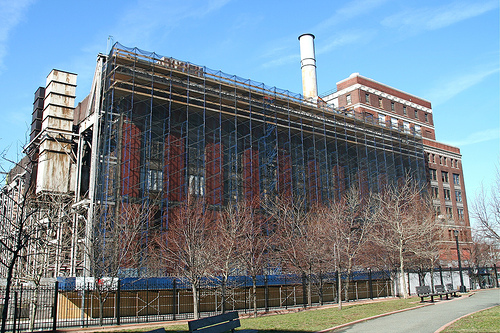
BMT Power Plant Coming Down?

2324964955_2fdec23639.jpg
BMT Power House
Photo: INSIJS

It looks like the former BMT power plant on Kent Avenue, just south of Division, is about to come down. I'm Not Sayin', I'm Just Sayin' has a post documenting the scaffolding of the building and commencement of demolition. He also has images of the building in its heyday, when it was constructed to supply power to the BMT surface railways - it was literally the power plant for Brooklyn's famed trolley system.

The building has been nominated for Landmark designation by the Roebling Chapter of the Society for Industrial Archaeology. In a recent letter Mary Habstritt of SIA (who is also a WGPA member), the Landmarks Preservation Commission said that, "based on our current priorities", the building would not be nominated for landmark status.

The BMT power plant was also one of the few buildings identified in the community-prepared 197-a plan for Williamsburg. In that plan, it was specifically called out as an important neighborhood historic resource. The plan called for the building to be designated a landmark.

INSIJS has much, much more on their site, including a number of historic images and a description of the building's history.

March 14, 2008

Tropic of Williamsburg

In the latest Brooklyn Paper, Tom Gilbert talks about the restoration of Henry Miller's boyhood home at 662 Driggs Avenue. Although not part of the original Fillmore Place development, this building is within the proposed Fillmore Place Historic District.

March 18, 2008

Retrofit Green

Via the RealDeal, a discussion of the state of green building in NYC. As the article points out, NYC lags behind many other cities in the number of green developments. In order to help make up the gap, the city is looking to promote green retrofits.

The article talks about many of the benefits of a LEED retrofit, but misses a big one: by preserving and retrofitting buildings, the vast store of energy embodied in the original structures is saved and huge amounts of demolition debris are kept out of the waste stream.

March 20, 2008

A Big Day for Williamsburg & Greenpoint

TransGasPlant.jpg

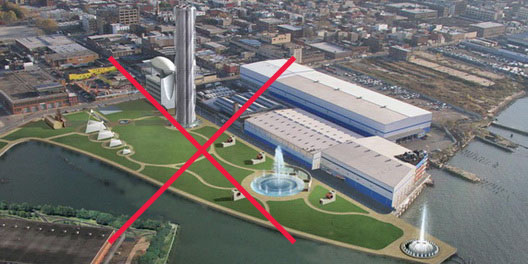
After seven and a half years, the state siting board has finally put the last nail in the TGE coffin. The board voted today to deny TGE's application to build an 1,100 megawatt power plant at the Bushwick Inlet. The ruling is significant in that it allows to City to move forward with acquiring the property (formerly the Bayside Fuel Oil site) and turning it into public parkland. For a neighborhood that ranks near the bottom in terms of open space per capita (and with our capita growing much faster than our open space), this is a momentous decision indeed.

Congratulations and thanks are in order for everyone who fought this project - in particular Assemblyman Joe Lentol, GWAPP, NBA and OSA and all the volunteers who trekked to Albany and fought this project every step of the way.

With any luck, we will soon have green open space, ball fields and maybe even a waterfront concert venue on the Bushwick Inlet.

UPDATE: The Brooklyn Daily Eagle has an article up on the victory, including details on the siting board's findings.

A Big Day for Grand Street

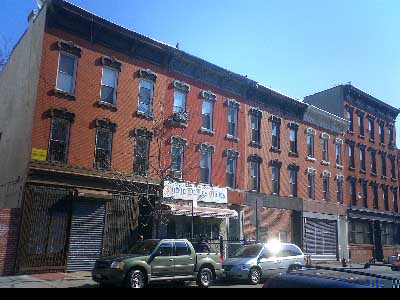
Grand.jpg
141 - 149 Grand Street


The Grand Street rezoning, which has been wending its way through the public approval since December, cleared its next to last hurdle today - the City Council's Land Use Committee voted to approve the rezoning with minor modifications. The next and last stop is a vote by the full Council, which could come as early as next week.

Once enacted, the zoning for all of Grand Street from Kent Avenue to Marcy Avenue will more closely reflect the existing context. Most blocks will be limited to buildings of four to five stories, with a density roughly in line with what was allowed previously. Out of scale "finger" buildings and developments that ignore the prevailing street wall will not be allowed.

Landmarks Steps in to Protect Windermere

Via the Times City Desk, a report about an LPC action to force the owner of the landmarked Windermere apartments on the west side to make repairs to the building.

The Windermere was landmarked in 2005, over the vociferous opposition of the building's owner. In order to bolster their case against landmarking, the owners hired attorney and author Andrew Alpern to testify against the designation. Alpern's "expert" testimony didn't win the day, and the building was landmarked. Alpern, who has written books on luxury apartments in Manhattan, was busy that year - he was also one of the hired guns brought out to offer "expert" opinion against the designation of the Austin, Nichols & Co. Warehouse. Landmarks didn't listen to him then, either.

March 21, 2008

BMT Power Plant update

Today's Brooklyn Paper has an update on the work at the former BMT Kent Avenue power plant. According to Con Ed, its just routine clean up, nothing to do with demolition or redevelopment.

BMT Power Plant update

Today's Brooklyn Paper has an update on the work at the former BMT Kent Avenue power plant. According to Con Ed, its just routine clean up, nothing to do with demolition or redevelopment.

MTA to G Train Riders: No

Today's Observer has an article about proponents of the G train who want the MTA to shift cars from the (relatively underused) V line to the (generally overcrowded) G line. The MTA says this is an engineering impossibility.

As Brooklyn booms, the G train is becoming more and more popular. Yet the MTA continues to cut back on service, resulting in shorter, overcrowded trains running shorter routes and serving fewer people.

More here.

Parking Permits

DOT Commissioner Jeanette Sadik-Khan has an op-ed in the Greenpoint Star about residential parking permits. For Williamsburg and Greenpoint, residential parking permits would be a significant part of the Mayor's congestion pricing plan. As it is, many people drive to Williamsburg and get on the L train. If congestion pricing goes into effect and it costs to drive to Manhattan, we can expect our neighborhoods to become even more of a park-and-ride lot. Residential permits would address this problem, while still allowing transient parking during the day.

The congestion pricing plan is an important issue for sustainability in New York City. The plan needs work in order to make it more equitable. But the concept itself is a good one, and it should not be scrapped to appease suburban drivers who contribute nothing to the City's infrastructure.

March 22, 2008

A Cautionary Tale

Economic downturns have a history of delaying, and sometimes killing, large construction projects in New York.

The reports about the potential demise of Bruce Ratner's Atlantic Yards project should serve as a cautionary tale for North Brooklyn. We too have been promised much, but little has been delivered. Yet still developers flock to Williamsburg and Greenpoint promising us the moon.

Nicolai Ouroussoff is right when he says that the public trust has been betrayed. Brooklyn was promised an architectural tour-de-force in Frank Gehry's design. And whether you like the overall Atlantic Yards plan or not, if only the arena gets built, we are getting ripped off culturally (and financially - WPA member Michael D. D. White has more on that here).

The proposed Domino development would be the second largest residential development project in the borough, behind only Atlantic Yards. Given the scale of the project and the tremors coursing through the credit markets, it is not unreasonable to ask the developers two very fundamental questions: 1) Do you have the resources to build it? and 2) What guarantees do we have that you will build it as you say it will?

Architecturally, the Domino project is bold and ambitious. But we've seen this before - remember that the Edge was originally to have been designed by Enrique Norten of TEN Arquitectos. All through the zoning, the community was told that on top of everything else, we would be getting world-class architecture on the waterfront. City Planning Commissioner Amanda Burden was particularly proud of Norten's involvement. But Norten turned out to be just bait - no sooner was the zoning enacted than we were given the switch - the developer dropped Norten for local architect Stephen B. Jacobs. (No knock on Jacobs, who is is a fine architect - but no doubt we - and DCP - were sold a bill of goods.)

Perhaps we need to resurrect an old cold war adage - trust, but verify?

March 25, 2008

Congestion Pricing at the City Council

Gotham Gazette has a three-part rundown (here, here and here, with background here and here) on the City Council's congestion pricing hearings, which started today. As we've said before, congestion pricing is generally a good thing, though the current plan certainly needs some equity tweaks.

Herewith, some excerpts and commentary:

Can you trust City Hall? The state? The Metropolitan Transportation Authority?

In the case of the MTA, no.

[Most] members wondered more about funding for projects in their individual districts. [Tish] James, for example, suggested a study to determine the feasibility of linking the G train to the IRT.

We'll be parochial and say "Thanks, Tish".

[If congestion pricing goes through,] there will be “more bus lines and new ferries and commuter train access.” But he [CM John Liu of Queens] said the MTA and the city must stick to the timelines for improving transit. “The big problem people have is they don’t trust the MTA and even city government for following through and using the money effectively.”

Right on both counts.

Regarding the "Jersey Inequity":

Because the congestion pricing proposal before the legislature subtracts tolls from the congestion fee — and sets the maximum that someone would pay to enter Manhattan at $8 a day — many people who cross the Hudson River will essentially get a free ride.

Its not clear if this applies only to the Jersey crossings directly into the congestion zone, or if it also affects other crossings from LI, Westchester, etc. But if the goal is to reduce the number of cars entering midtown, you need to raise the price of admission for everyone. That's the whole point of a disincentive - to change behavior. Charging toll-paying drivers the same amount they are paying now does not create much of a disincentive.

And contrary to what a commenter says, Jersey drivers have not been paying a "congestion" toll for decades. They have been paying a usage toll for the use and upkeep of the bridges and tunnels (and whatever else the PA chooses to use the money for). City bridges (though not tunnels) are free, but we pay for them via taxes.

Regarding E-ZPass:

But whatever the merits of the E-ZPass, the preferential treatment given those who have them raises concerns about equity. To get an E-ZPass, a person needs to have a credit card or bank account, keeping it out of the reach of some poor New Yorkers.

You also need a car, and to drive a car, you need insurance. You need gas too. None of those are cheap. So its not clear how many poor New Yorkers we are really talking about here. On the other hand, a lot of people (poorer and otherwise) use the free bridges and as a result don't use E-ZPass now, or use it infrequently. Under the congestion system, drivers will rack up $120 in charges per month - that's a lot of E-ZPass refills hitting your credit card (or bank account). No doubt the fee itself is regressive, but the preference for E-ZPass is the least of that problem.
Street Trees

The City Planning Commission has approved a zoning resolution that would require one new street tree for every 25' of street frontage on new developments and large rehabs. CPC estimates that this measure will result in 10,000 new trees being planted. Williamsburg and (ironically) Greenpoint have among the lowest levels of street trees (or any trees, for that matter) per capita, so hopefully at least half those new trees are headed here.

Street Trees Are No Longer an Optional Accessory [NYT]

March 26, 2008

Grand Street Rezoning Approved

This afternoon, the City Council voted to approve the rezoning of Grand Street between Marcy and Berry, and surrounding blocks. The implementation of "contextual zoning" on these blocks will limit building heights to match the surrounding neighborhood fabric. The new zoning also eliminates the much-abused "community facility bonus".

Bldg. 'Cap' in W'burg [NYPost]

March 28, 2008

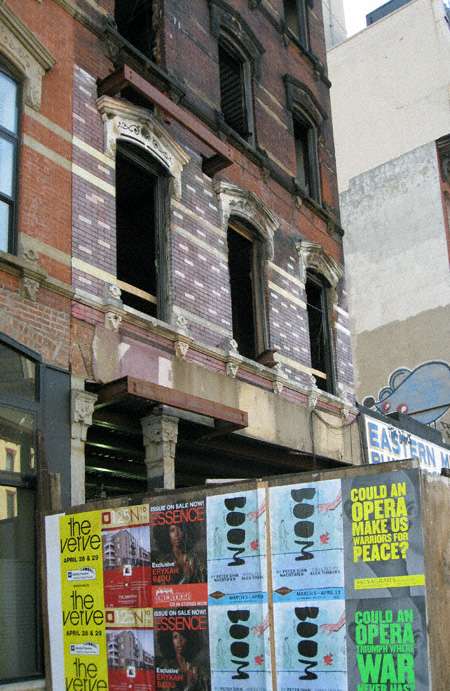
152 Broadway

152-balconies.jpg
152 Broadway
Photo: newyorkshitty.com


We noticed this particularly insensitive rehabilitation on Broadway a few weeks ago. Even went so far as to take pix with the camera phone. We meant to go back and get real pictures to post here, but newyorkshitty.com beat us to it.

What initially caught our eye was the demolition of the front facade in order to install "Juliette" balconies. From the looks of it, these balconies aren't even large enough to stow a bicycle, rendering them completely useless. What we hadn't noticed (again, thanks newyorkshitty), was the DOB permit and the rooftop addition. It seems that (in yet another Fekete special) they are turning this four story building into a six story building. And if the balconies are any indication of the sensitivity to design and historic fabric, this is not going to be a little Hearst Tower on Broadway.

152-broadwaynys.jpg
152 Broadway
Photo: newyorkshitty.com


This is a shame because this building, which probably dates to the 1870s or so, has a twin next door that was just rehabbed. That rehab won't win any preservation awards, but the developer at 154 did a nice job and didn't destroy any historic fabric in the process. In fact, 154 Broadway was the latest of such rehabs up and down the strip of lower Broadway. We would add to that the conversion of the "new" Smith-Gray Building at the corner of Bedford (the "old" Smith-Gray, a landmark, is down the street), the rehab of the former Bedford Avenue Theatre on South 6th Street, and a number of small storefront and building rehabs west of Wythe. Even the Gretsch conversion managed to retain some of the historic character of its industrial past.

Much of Broadway, from Kent Avenue to almost Roebling Street, has the potential to be part of a local historic district. There are already three individual landmarks in that stretch, and at least as many more buildings that could be individual landmarks. Unfortunately, for every Bedford Theatre there is a 152 Broadway - a rehab that not only diminishes the character of the street, but one which diminishes the historic character of the street. Hopefully, the Landmarks Commission will pay attention before its too late.

About March 2008

This page contains all entries posted to WGPA in March 2008. They are listed from oldest to newest.

February 2008 is the previous archive.

April 2008 is the next archive.

Many more can be found on the main index page or by looking through the archives.

Creative Commons License
This weblog is licensed under a Creative Commons License.