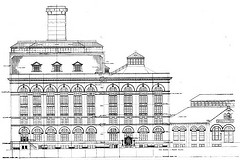
Historic drawing of the Kent Avenue BRT plant.
Courtsey of INSIJS
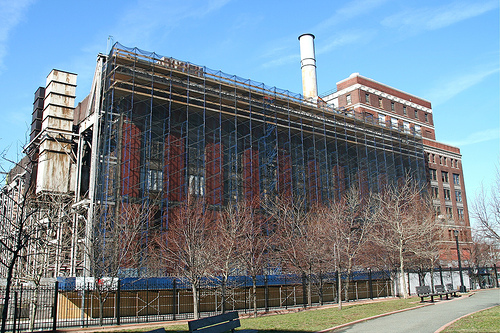
Today's issue of the Brooklyn Papers has some more information on the impending demolition of the Kent Avenue BRT power plant. As we learned last week, Con Edison (who now owns the former plant) has finally admitted that they intend to demolish the structure. But they still won't say what they will do with the site. Will it be residential (the odds-on favorite), or go some other use?
As with many older buildings, the opportunities for adaptive use here are many. But without an idea of what is planned for the site, its much harder to make that case. And surely, Con Ed knows this. Surely, too, Con Ed will cite all sort of factors as to why the building cannot be saved. But most of these are likely to be red herrings. Take the most obvious - environmental remediation. Con Ed will say "well, the building is full of toxins, we have to take it down". But whatever toxins are in the building (asbestos, PCBs) can be removed with the building in place. The incremental cost of remediation is not likely to be significantly higher, and either way, the toxins within the structure will have to be removed and safely disposed of.
From a sustainability point of view, it makes far more sense to leave the building in place and adapt it for a new use. Throwing away the whole building is a waste of the resources and energy that went into the construction of the building in the first place. In the past few years, there have been at least two local projects that have proposed the reuse of large shell structures such as this. One is the Domino refinery, where CPC resources is proposing a building-within-a-building solution. The second is the Powerhouse condos in Long Island City. There, a former LIRR power station (a building with a very similar history to the BRT power station) is in the final stages of conversion to housing. The sensitivity of the conversion from a historic preservation point of view leaves much to be desired (to put it gently), but its not a total tear down.
Put very simply, under just about any development scenario, this building could be cleaned up and reused. The building could be adapted for housing (luxury, affordable or otherwise). It could also be adapted for industrial use and incorporated into the Brooklyn Navy Yard (which has clearly sghown that there is a demand for good industrial space). The only development scenario that would not be feasible with the building in place is if the site is turned into a waterfront park. But that is the only development scenario that "requires" that the building be removed.
[Updated with links.]