« May 2008 | Main | July 2008 »

June 2008 Archives

June 4, 2008

Brooklyn Eagle: Preserve the Rest of Brooklyn

In an op-ed on the demolition of 100 Clark Street, the Brooklyn Eagle has this to say about the rest of Brooklyn:

However, in areas such as Bushwick, Bedford-Stuyvesant, Sunset Park and East New York, there are 19th century buildings in terrible condition that are only sporadically repaired, or, in some cases, vacant. These buildings may also be in danger of falling down. Yet, who will take up their cause? ...Perhaps it’s time for our academic institutions, city agencies, architects, non-profits and grant-making businesses to show as much interest in preserving other areas of the borough as they do in preserving Brooklyn Heights, Carroll Gardens, Boerum Hill, Fort Greene and Park Slope.

We couldn't agree more.

Caring for Street Trees

evagram-tree.jpg
Photo: evagram

There are still a few spots available for the Street Trees Workshop in Greenpoint next Wednesday. Please see below info if you would like to participate!

Caring for Street Trees Workshop
Presented by the New York Tree Trust
Green Oaks Club, 179 Green St. between Manhattan and Mc Guinness
Greenpoint, Brooklyn
Wed. June 11, 7 p.m.-9 p.m.

In this basic workshop, you'll learn to care for young street trees, receive free tools, and get a Parks Volunteer Permit, which will allow you to care for street trees and greenstreets. Advance registration is required; space is limited.

To register, contact channaly.oum@parks.nyc.gov or (212) 676-1929 with your name and email and/or phone number. The workshop is hosted by GWAPP'S North Brooklyn Tree Project.

June 9, 2008

BMT Power Plant Eligible for National Register

We've just received notice that the New York State Historic Preservation Office has determined that the BMT Powerhouse at 500 Kent Avenue is eligible for listing on the National Register of Historic Places. This determination is not as restrictive as a NYC landmarks designation, but it does mean that any work involving state or federal action (i.e., financing or permits) requires a review by SHPO.

June 11, 2008

Weidmann Cooperage Hotel

weidman-2.jpg
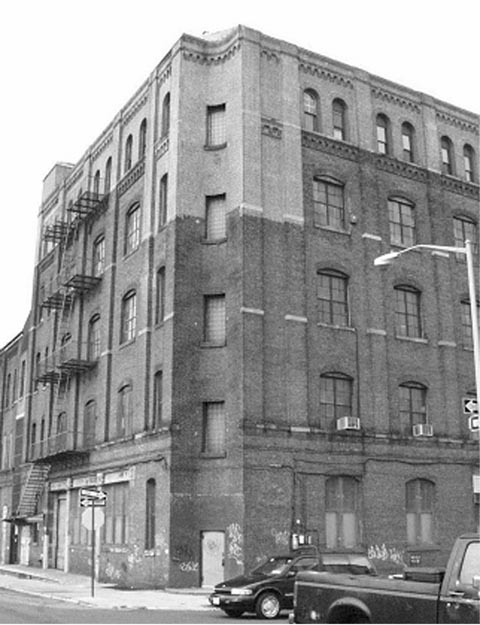
Weidmann Cooperage, North 11th and Wythe
Theobald Engelhardt, architect (c. 1901)

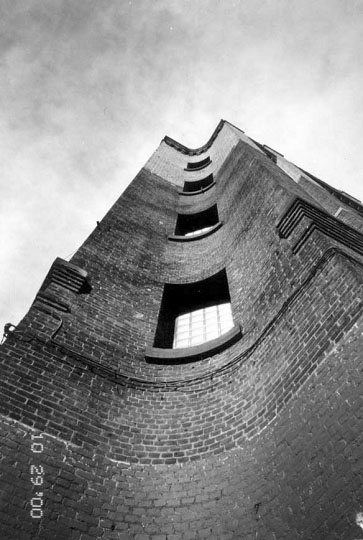
Curbed had a posting recently that may spell the beginning of the end of the Weidmann Cooperage building at North 11th and Wythe. The building, which was designed by architect Theobald Engelhardt and constructed in 1900, is notable for its concave reentrant corner. This is believed to have been the location of an iron barrel chute, used for unloading barrels from the cooperage, or a spiral fire stair.

Paul Weidmann's first cooperage was located on the East River at North 3rd Street as early as 1881. It was a major supplier of barrels to local sugar refiners and other businesses. In 1884, Weidmann acquired the block along the East River between North 6th and North 7th to expand his operations. During this time, Weidmann's operated as the cooperage for the Sugar Trust, the trust controlled by the Havemeyer family. At some point around 1890, Weidmann sold out his interests in the cooperage to the Trust, which in turn formed the Brooklyn Cooperage Company under the leadership of Lowell M. Palmer (hence, Palmer's Dock).

During the 1890s, Weidmann used the proceeds from the sale of his cooperage to start a brewery and speculate in real estate. The Weidmann Brewery was located on North 1st near Berry. Among Weidmann's real estate ventures was the purchase of the property immediately east of Steeplechase Park in Coney Island. In 1893, Weidmann and his sons Paul Jr. and Louis were back in the cooperage business with a new plant at North 11th and Wythe. This new Weidmann's cooperage was established to serve the independent sugar producers, of which there were a number in north Brooklyn. At its peak production, the North 11th Street cooperage could produce between 6,000 and 7,000 barrels a day.
WEIDEMAN.JPG
Weidmann Cooperage
Corner detail

The North 11th Street cooperage burned in June, 1900, killing at least 6 workers. Following the fire, the Weidmanns hired Engelhardt to design the current building, construction on which was begun in 1901. Theobald Englehardt was the most prolific and eclectic architect of the turn of the 20th Century. Among others, he was responsible for the design of the North Side Savings Bank at Grand and Kent and the former Old Dutch Mustard Company building at Metropolitan and Wythe, among others.

The cooperage was nominated as a local Landmark by the Municipal Art Society in 2005, and WGPA has asked the Landmarks Commission to consider the building in light of these latest developments.

According to Curbed and DOB, a hotel conversion is planned for the site. The project is being developed by Two Trees Management, the DUMBO development company of the Walentas family, and is designed by Marris Adjmi Partners architects. Adjmi has designed a number of new buildings in historic districts, and is known for his modernist yet contextual aesthetic. Based on the DOB filing, which describes a three to four-story rooftop expansion, Adjmi has his work cut out for him.

In the 2005 Williamsburg rezoning, the Weidmann site was left in a small pocket of manufacturing centered on the Bushwick inlet. That pocket was intended to protect manufacturing uses in an area that a particularly high concentration of such uses. Hotel uses are allowed as-of-right in this manufacturing zone, a facet of the zoning code that has raised a variety of concerns in recent years.

In addition to the Curbed posting, the Brooklyn Eagle has an article out today which adds little information (and gets the date of the building wrong).
Place Matters Celebrates 10th Anniversary


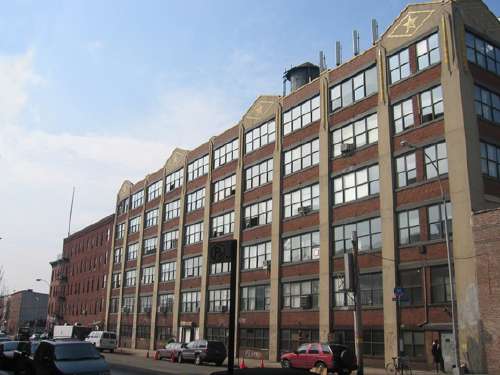
This evening, City Lore and the Municipal Art Society are honoring 10 great places around the 5 boroughs for the ways they contribute to our communities and city. The event is also a celebration of the 10th anniversary of Place Matters, a project of the two organizations. This evening's event is sold out, but Place Matters has prepared the video above for those who cannot attend.

The full list of honorees is below. Clearly for us, the highlight is the Greenpoint Manufacturing and Design Center, located on Manhattan Avenue and Newtown Creek.

The 10 Place Matters honorees are:

  • Federation of Black Cowboys, Howard Beach, Queens
  • Greenpoint Manufacturing & Design Center, Greenpoint, Brooklyn
  • JCR Percussion, Highbridge, Bronx
  • La Plaza Cultural Armando Perez, Lower East Side, Manhattan
  • Mandolin Bros. Ltd., West New Brighton, Staten Island
  • A.J. Muste Building (Peace Pentagon), Noho, Manhattan
  • Snug Harbor Cultural Center, Staten Island
  • THE POINT Community Development Corporation, Hunts Point, Bronx
  • Weeksville Heritage Center, Crown Heights, Brooklyn
  • West 4th St. Courts, "The Cage," Greenwich Village, Manhattan

June 18, 2008

Brooklyn's Vanishing Industrial Heritage

Starting today and running through August 30th, the Brooklyn Public Library will feature an exhibition of photographs by Nathan Kensinger called "Twilight on the Waterfront: Brooklyn's Vanishing Industrial Heritage." In the exhibit, Kensinger documents off-limits industrial sites along Brooklyn's waterfront, shedding light on what Brooklyn has lost to development over the last five years. Kensinger's work has included documentation of Domino Sugar and the Greenpoint Terminal Market.

The Library is hosting an opening night meet-the-photographer reception starting at 7:30 this evening.

June 23, 2008

HDC Summer Lecture: Our Latest Landmarks

61_greenpoint.jpg

Pencil Building.

The Historic District Council's first lecture in in its 2008 Summer Lecture Series features some Greenpoint flavor (and some industrial DUMBO goodness).

Tuesday, June 24, 2008, 6:00pm
Neighborhood Preservation Center, 232 East 11th Street, Manhattan
Our Latest Landmarks: Recent & Upcoming New York City Historic Districts

HDC’s Executive Director Simeon Bankoff will present an overview of recently designated and calendared historic districts throughout New York City, as well as what’s next in the pipeline. This panel will feature some of the city’s most hard-working preservation activists as they discuss the landmarking process from a community perspective. Participants will include Doreen Gallo of the DUMBO Neighborhood Association; Paul Kerzner of the Greater Ridgewood Restoration Corporation; Martina Salisbury, a tenant of the Eberhard Faber Pencil Company Historic District and preservation advocate; and a representative from the NoHo community.

The lecture is free, and there is a reception to follow. But space is limited, so reservations are required. RSVP at 212-614-9107 or kmorith [at] hdc [dot] org

June 24, 2008

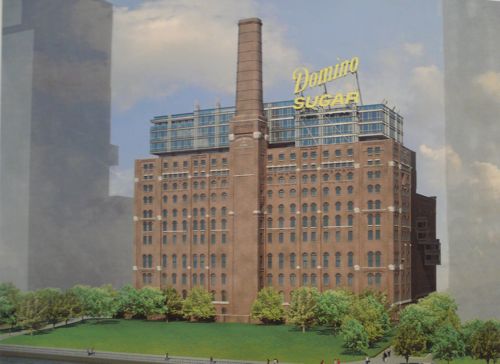
Domino Addition Approved, Sign Saved

new-domino-01.jpg

Approved Domino Expansion
(Photo courtesy of Brownstoner)

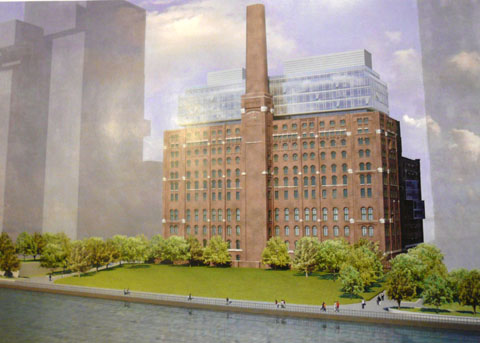
Brownstoner has a blow-by-blow description of the Landmarks Commission's follow up hearing on the proposed Domino Refinery building redesign, and based on the images he has posted, the results are impressive. The glass addition has been scaled back some, but more importantly, it has been redesigned to have a less sleek, more integrated appearance. In other words, it no longer appears as an afterthought plopped down on the Refinery, but now reads as part of the rehabilitation of the refinery itself. It also helps that the ridiculous bulkheads on top of the addition are now gone.


river_rendering.jpg

Previous Scheme (Rejected by LPC in February, 2008)

Of course the other piece of big news is that the Domino sign is saved, and will be installed on top of the new addition (on the lower portion). This is good news for the sign, and an appropriate gesture given that historically, there was a large illuminated sign on top of the Refinery.

Some of the other details are less clear from the initial posts. The new storefronts at the base of the building were completely out of place in the old design, and have apparently been redesigned, but we haven't seen the details. The chutes on the south side of the building seem to have grown larger and crazier, but we'll withhold judgement until we see better images. And the new window openings and windows still seem rather trite and banal, but we'd like to see more information on this too.

We also note that CPC has finally put a price tag on the preservation of the refinery - an addition $40 million to the overall project cost. Its not clear if this means $40 million above and beyond what it would have cost to demolish the refinery and build something new on the site, but this number in and of itself certainly doesn't seem to justify the massive increase in density CPC is looking for on the overall project.

June 25, 2008

Inside the BRT Powerhouse

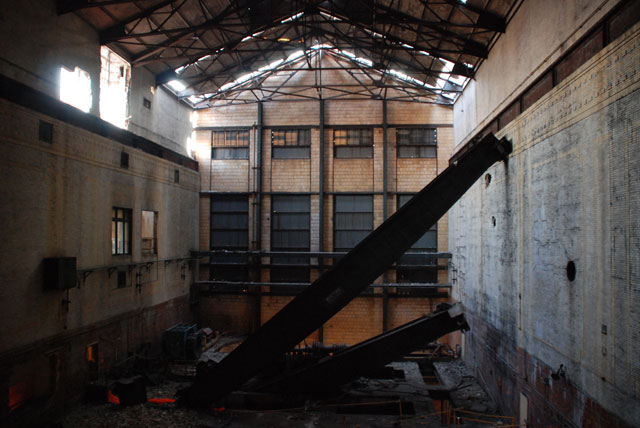
kensinger_500_kent.jpg

Turbine Hall, BRT Powerhouse
Photo: Nate Kensinger (via Gothamist)

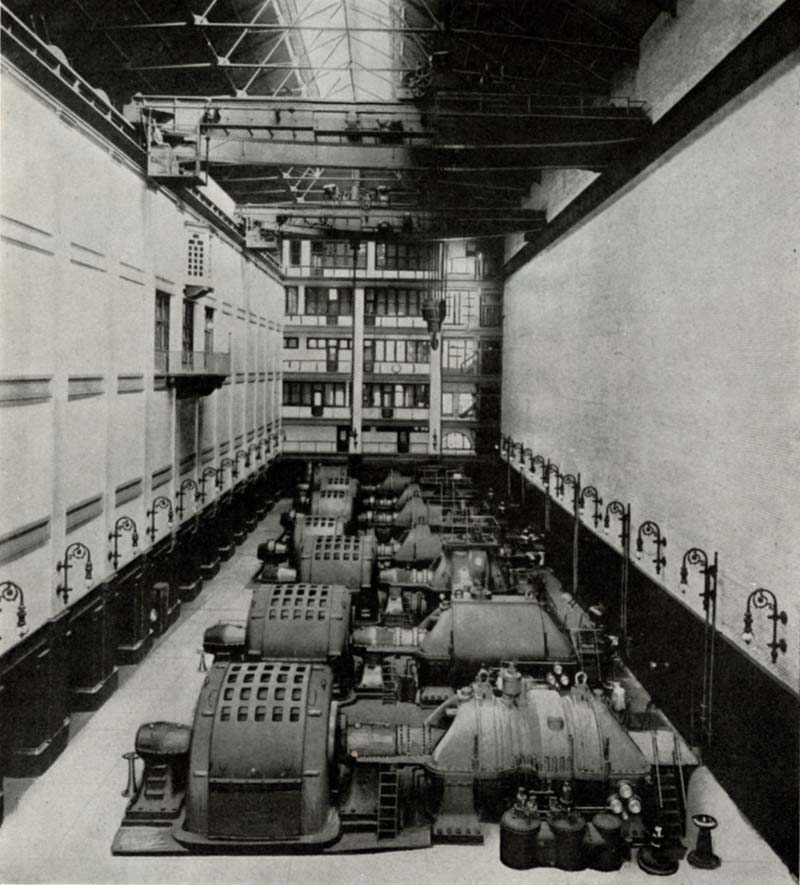
BMTturbinehall.jpg

Turbine Hall, BRT Powerhouse (1931)

Via Gothamist, Nate Kensinger has photos from inside the BRT Powerhouse at 500 Kent Avenue. As shown in the first photo above, Con Ed has pulled most of the stuff from out of the building, leaving just the shell. It is the shell, of course, that is most architecturally significant. It is also the shell that is least likely to contain hazardous materials.* So maybe Con Ed could stop here, and put the building to good use rather than putting it into a landfill.

As the historic photo above shows, the Turbine Hall was always a large clear-span space. The only change is the removal of the turbines themselves and the loss of decorative details such as light fixtures. Even open to the elements, the grand space is largely intact and eminently salvageable. (For a view of the Turbine Hall before demolition, take a look here.)

* Copies of environmental reports obtained by WPA make no mention of any remediation needed to the structure itself, beyond the typical asbestos encased piping and lead paint that one would find in any building of this vintage - industrial, commercial or residential. All of the hazardous material was located in machinery within the building (which has clearly been removed), or in the ground outside the building. The most significant environmental at this site actually appears to come from the next door site to the south, which was at one time a manufactured gas plant belong to Brooklyn Union Gas. There is (was) also hazardous materials in an ash pit located at the northwest corner of the site (adjacent to 470 Kent), also outside the historic structure.

About June 2008

This page contains all entries posted to WGPA in June 2008. They are listed from oldest to newest.

May 2008 is the previous archive.

July 2008 is the next archive.

Many more can be found on the main index page or by looking through the archives.

Creative Commons License
This weblog is licensed under a Creative Commons License.