Fillmore Video
Sarah Nelson Wright has made a wonderful video about Fillmore Place, its residents and its very special qualities. (If the embed doesn't work for you, click here.)

« September 2007 | Main | November 2007 »
Sarah Nelson Wright has made a wonderful video about Fillmore Place, its residents and its very special qualities. (If the embed doesn't work for you, click here.)
Another Fillmore Friday excerpt from WPA's nomination for the proposed Fillmore Place Historic District. This week, a bit about the developers Clock & Miller, the buildings themselves, and who lived there.
Clock & Miller
Alfred Clock and Ephraim Miller were local merchants, real estate developers and prominent citizens of the Village of Williamsburgh. The two appear to have been active in Williamsburgh real estate as early as 18328, and by the 1850s were prominent citizens of the City of Williamsburgh.
Alfred Clock was born in Darien, Connecticut, in 1802. As early as 1832, he was in Williamsburgh investing in real estate. His daughter Eveline married Jeremiah Meserole, thus marrying into one of Williamsburgh’s most prominent families. Together with Miller, Clock Sr. purchased at least one property from Jeremiah’s father, Abraham Meserole.
Although they sold most of the Fillmore Place properties soon after the new street was laid out, Clock & Miller held onto and rented out some properties into the late 1850s. The pair also owned properties at 86 North Second Street (now Metropolitan Avenue) and 189 Grand Street.
Patterns of Development and Ownership
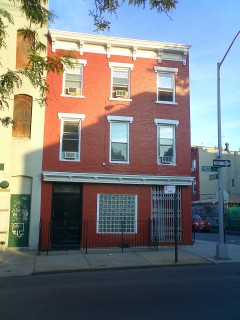
667 Driggs Avenue. Sold by Clock & Miller to attorney/
investory Charles Briggs in 1854. The ground floor
historically housed a store, and was home to Peper's
grocery & liquor store in the 1860s and Gorman's
dry goods store in the 1880s and 1890s. The rear
of the property, on Fillmore Place, contained a stable
(now a separate lot).
Clock & Miller began acquiring the Fillmore properties in 1847, and appear to have completed acquisition by 1852. While the development concept (the master plan) and the cutting through of Fillmore Place appear to have been the work of Clock & Miller, there may have been other partners and speculators involved in the development and construction of Fillmore Place. Three other people bought multiple lots from Clock & Miller very early in the course of development. These included John Hamilton (acquired 675 and 677 Driggs in 1853); Absalom Roper (acquired 9, 11 and 27 Fillmore in 1852); and Jacob Sheppard (acquired 12 and 26 Fillmore in 1856 and 1860, respectively). Each of these development partners held onto their properties for a very brief period – at most five years, and usually one to three years. In addition, there appear to have been a number of other development partners or speculators who bought into the project early on and sold their properties with a year or at most two years. These include attorney Charles Briggs (667 Driggs), pilot William Gibson (30 Fillmore) and John O’Rourke (24 Fillmore). Although other developers and possibly builders were involved in the Fillmore Place development, it is clear that all the buildings were designed by the same hand, using the same palette of design details.
There were, of course, many who bought into the project for long-term investment purposes. Most of this latter class of buyers lived in the houses they purchased, for anywhere from 5 to 25 years. Buyers in this class, all of whom bought directly from Clock & Miller, include painter/paper hanger Enos Baker (10 and 24 Fillmore, 7 and 16 years respectively); joiner Thomas Coger (19 Fillmore, 20 years); and coppersmith Charles Heyman (170 Roebling, 31 years).
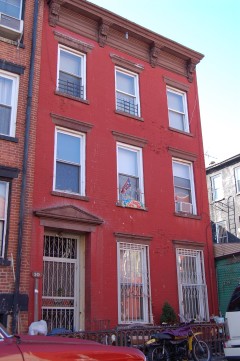
10 Fillmore Place. Sold by Clock & Miller to Enos
Baker, a painter and paper hanger. Baker, who
also owned 24 Fillmore, lived at number 10 until
the early 1870s.
All of the Fillmore Place buildings were occupied as multi-family residences – what were probably termed at the time flat houses (a class above the tenement, a term that was only coming into widespread usage in the 1850s). The patterns of ownership and occupancy in later years very closely match that of the surrounding area of Williamsburg. In the mid-19th century, most of the owners were English, Irish or German, and worked as artisans or were petty merchants. The residents renting apartments on Fillmore Place at this time were of a similar background, usually artisans, clerks and laborers.
By the late 19th-century there was an increasing representation of Eastern Europeans among the owners and renters. These included Christian and Jewish Poles, Lithuanians, Estonians and Ukrainians. The Jewish residents represented the advance wave of Jewish immigrants who moved from the Lower East Side in large numbers beginning in 1903, with the opening of the Williamsburg Bridge. From that point forward, much of the Southside and South Williamsburg came to be predominantly Jewish. Although the Williamsburg Bridge was certainly the catalyst for large number of Jews relocating to North Brooklyn, the influx of Jews certainly predated the construction of the bridge, as witnessed by the owners and residents of some of Fillmore Place buildings. Many of these earlier Jewish residents worked in the garment trades, as furriers, tailors and cutters.
The Christian immigrants from Eastern Europe tended to settle in the Northside, with Grand Street seeming to be the soft dividing line between what was becoming Baltic and Polish Williamsburg to the north and Eastern European Jewish Williamsburg to the south. Through 20th century, Fillmore Place continued to attract Baltic and Polish émigrés. Beginning in the 1930s, Hispanic names begin to appear in the conveyance and directory records, reflecting the influx of Puerto Rican transplants. Over time, Southside Williamsburg would come to be one of the largest centers of Puerto Ricans in New York City, a demographic heavily reflected in Fillmore Place.1
Throughout most of its history, the Fillmore Place houses have been a combination of owner-occupied and rental housing. Some of the houses were owned by absentee landlords and rented out entirely, while most were owner-occupied with portions of the houses rented out. In a few cases, the houses appear to have been entirely owner occupied.
Many of the Fillmore Place property owners owned multiple houses on the block. This was the case in the early years of development, when speculators bought multiple properties from Clock & Miller. In the late 19th century and early 20th century, William Dailey bought up numerous properties. On his death circa 1929, Daily owned at least four houses on Fillmore Place.
1. One of the major impetuses for the movement of Puerto Ricans to New York City was the displacement of tenant farmers on the island that came about as a result of American Sugar and other sugar refining companies buying up large tracts of land and turning them over to sugar cane. Ironically, many of these displaced farmers wound up on the Southside working at the American Sugar’s Kent Avenue refinery, one of the largest sugar refineries in the world.↩
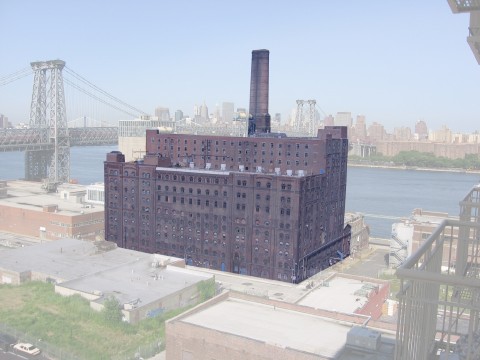
Domino Sugar Refinery, Processing House, view looking west towards Kent Avenue
Photo: michaelsharon
Worth a read: the Landmarks Preservation Commission has posted its designation report (pdf!) for the Pan, Filter and Processing House. The report is a much more in-depth study of the Havemeyers & Elder Refinery than our own report (prepared over two years ago). LPC's report includes a discussion of the architectural, industrial and social significance of the refinery, and includes a number of pieces of information that we were not able to discover.
Most significantly, LPC is able to attribute the design of the structure to Theodore A. Havemeyer, and discovered that plans for the colossal refinery were filed two months before the 1882 fire that destroyed the original Havemeyers & Elder Williamsburg refinery. (The existing refinery was constructed a block north of the pre-1882 refinery.)
The photo above, which WPA first featured this past June, made the report.
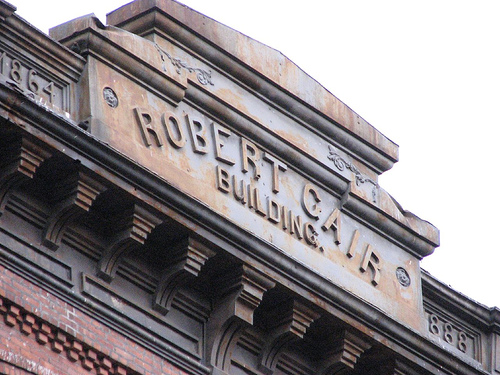
Photo: dumbonyc
Next week, the Landmarks Commission will be holding a marathon public hearing/public meeting that will focus exclusively on designation of new landmarks and historic districts. By far the largest item of the day will be the long-overdue initial hearing for the proposed DUMBO historic district.
There is, of course, another small district that is scheduled to be designated. But all of that is a week away. In the meantime, here is architectural historian Francis Morrone on DUMBO.
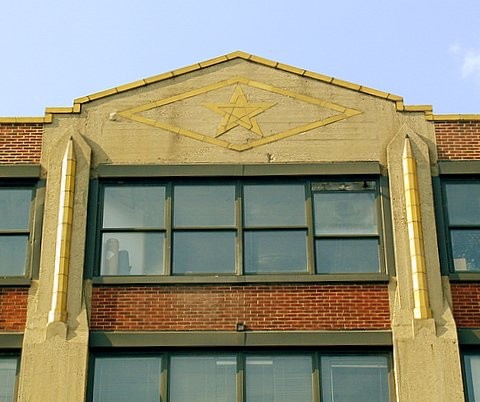
61 Greenpoint Avenue, detail.
As we mentioned before, LPC is holding a mega-designation hearing on Tuesday the 30th. In addition to the initial Dumbo hearing, Landmarks is expected to designate the Eberhard Faber Historic District. The Eberhard Faber district encompasses most (though not all) of the buildings of the former Eberhard Faber Pencil Factory.
The Eberhard Faber Historic District will sit side by side with the larger Greenpoint Historic District and the Astral Apartments, and individual landmark. The former is comprised largely of 19th-century residential buildings for the managers and owners of Greenpoint's factories and businesses. The latter was constructed by Charles Pratt to house the workers of his Astral Oil Works. All in all, the three designations encompasses factories, businesses, houses of worship and housing - forming a very unique view of a close-knit 19th-century community.
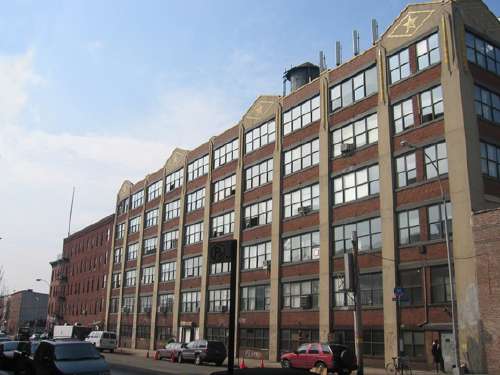
61 Greenpoint Avenue (ca. 1930)
The Landmarks Preservation Commission voted today to designate the Eberhard Faber Historic District. This is the latest in a series of designations of industrial buildings in Williamsburg, Greenpoint and beyond (and comes on the same day that the Commission heard testimony on the proposed Dumbo historic district).
The Times has the full run-down on designation day at LPC.
Brownstoner had a live report from the scene, which Curbed picked up.
The quote of the day, via Brownstoner, attributed to one of the Commissioners: "development fever is raging through the neighborhood — as well as fires — so the sooner this is protected, the better." Unfortunately, the designation did not come soon enough to protect two former Eberhard Buildings. Nonetheless, this is another significant designation for Greenpoint and North Brooklyn.
This page contains all entries posted to WGPA in October 2007. They are listed from oldest to newest.
September 2007 is the previous archive.
November 2007 is the next archive.
Many more can be found on the main index page or by looking through the archives.
